

Every losing campaign produces a crowd of people who swear they saw it coming.
Most of them kept their mouths shut when it actually counted.
But one man in President Trump’s inner circle spoke up long before voters lined up at the polls, and his warning just leaked.
What Vance Told the President Behind Closed Doors
Axios pulled back the curtain on months of private arguments inside the White House over the war with Iran, citing sources familiar with the discussions.
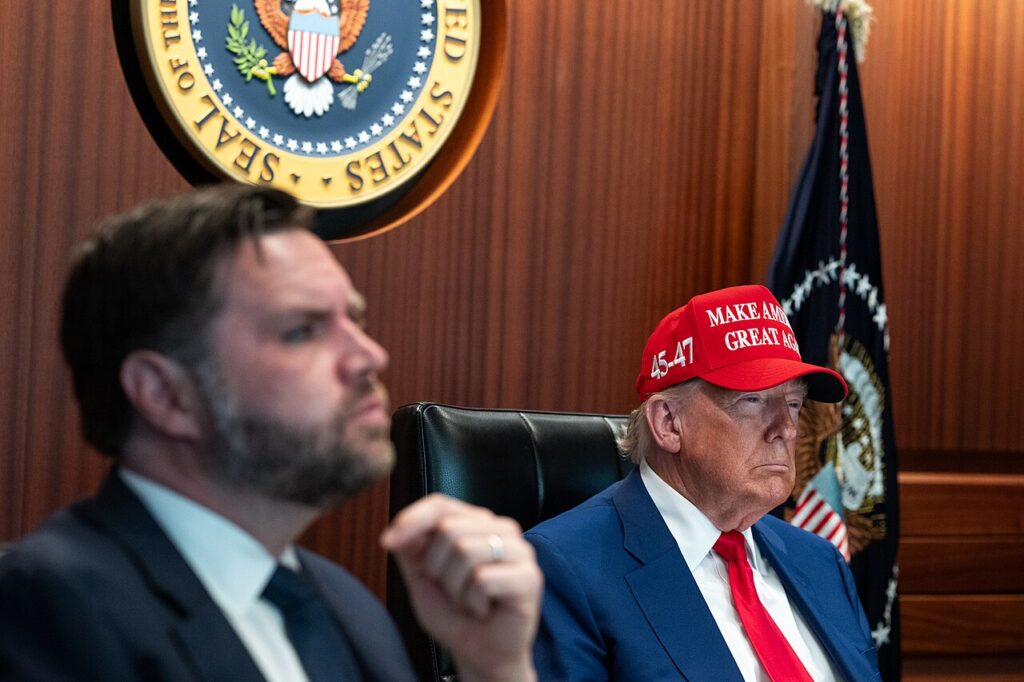
According to the outlet, Vice President JD Vance led a faction of Trump’s inner circle that kept pushing the President to strike a deal with Tehran and end the conflict instead of going back to bombing.
Vance didn’t dress it up. Sources told Axios he warned Trump that the war was unpopular and could cost Republicans the election.
And he wasn’t a lone voice. Axios reported that most senior officials around the President shared his read.
The Vice President also took aim at the foreign leader who spent the most energy pressing for more strikes. Vance privately accused Israeli Prime Minister Benjamin Netanyahu of “being wrong on everything” about Iran, Axios reported, citing sources.
Trump still leaned toward resuming the fight. Axios reported that he weighed strikes before the midterms while Netanyahu pressed him to act, then decided to wait.
That decision ages better by the hour.
Then the returns came in. Democrats seized both chambers of Congress, and Vance went on X with a sentence few politicians in either party would have the nerve to type.
“The reason we lost is the war,” Vance wrote.
He added a line that told everybody where the President stood. “The president himself said so last night,” Vance wrote, according to ABC News.
Reporters carried the post straight to the White House, and Trump didn’t run from it. “I think it’s largely true because it drove the gasoline up a little bit short term,” Trump said.
But Trump also stood by the original call. “You can’t let Iran have a nuclear weapon,” he said, according to ABC News.
Both things can be true at once. Stopping a nuclear Iran was a legitimate goal. Letting the fight drag on month after month, with no exit ramp and gas prices climbing, turned a defensible strike into a political anchor.
The Memo Lyndon Johnson Tossed Aside
Washington has watched this movie before, and the ending wasn’t pretty.
In the winter of 1964 and 1965, President Lyndon Johnson’s top foreign policy hands lined up behind a sustained bombing campaign against North Vietnam. Under Secretary of State George Ball didn’t.
Ball wrote a long, blunt memo in February 1965 warning Johnson about the disaster escalation would bring. He worried it would die on somebody’s desk, so he slipped it to the President through aide Bill Moyers.
But it didn’t matter. The bombing started anyway in March.
That summer, Ball tried again with a memo titled “A Compromise Solution for South Vietnam,” urging a negotiated settlement. Defense Secretary Robert McNamara pushed the other way and told Johnson to expand the American presence fast. Johnson sided with McNamara, and within weeks he authorized 44 US battalions for South Vietnam.
Everybody knows the rest. Republicans picked up 47 House seats in the 1966 midterms, and by 1968 Johnson walked away from a second full term rather than face the voters.
History remembers Ball as the man who got it right while the smartest guys in the room got it wrong.
And there’s a detail about Ball that matters here. He stayed on the team. He argued inside the building and kept his loyalty outside of it.
And Vance has played it the same way. ABC News noted that the Vice President publicly backed the war in the past and went after the President’s critics. Behind closed doors, according to Axios, he made the opposite case to the one man whose vote counted.
That’s what a real adviser looks like. The ones who flatter a President into a quagmire never seem to pay the bill themselves.
Why the Deal Path Still Beats the War Path
Now Trump has a choice, and Axios laid out three roads. He can resume major strikes. He can negotiate a deal. Or he can keep the naval blockade and sanctions in place and keep squeezing Tehran.
The neoconservative wing already knows which one it wants. These are the same voices who sold the Iraq War and have spent two decades hunting for the next Baghdad.
Some of them showed up fast. Ari Fleischer, who stood at the White House podium for George W. Bush during the run-up to Iraq, broke with Vance on what cost Republicans the midterms, according to Fox News.
Of course he did.
The hawks want this election to be about anything else. ICE, tariffs, a MAGA message that supposedly went too far. But the numbers keep pointing back at the war.
Exit polling showed voters who called immigration enforcement crucial broke for Republicans 58 to 40. An Echelon Insights survey of 2024 Trump voters who now disapprove of him found only 3 percent named tariffs and trade, while 15 percent pointed to foreign policy and wars, including Iran.
And a Reuters/Ipsos poll found 77 percent of registered voters held Trump at least partly responsible for the jump in gas prices that followed the start of the war. Gas climbed to about $4 a gallon, roughly a dollar above prewar levels, according to Reuters.
Mass deportations didn’t push gas to $4. A war did.
The hawks do have one argument left. Mohsen Rezaei, secretary of Iran’s Supreme National Security Council, claimed Tehran handed Trump a “strategic defeat,” and Axios noted Iranian negotiators could sense weakness and raise their demands at the table.
Fair enough, as far as it goes. But the crowd making that argument made the same one about Saddam Hussein, about the Taliban, and about every regime that sat one more bombing run away from collapse. Their track record is the reason Vance’s warning carried so much weight in the first place.
Trump already sounded like a man leaning toward patience. The day before the election, he said he was in no hurry to resume the war and preferred economic pressure to push Iran toward a deal, Iran International reported.
That instinct is the America First instinct. Voters sent him to Washington with it in 2016 and again in 2024, when he promised to end the forever wars rather than start new ones.
Vance spent months making that case quietly. He made it loudly once the votes were counted, and the President agreed with the diagnosis.
Lyndon Johnson had his George Ball and chose Robert McNamara anyway.
Donald Trump has two years before voters weigh in again. Will he be the President who finally takes the memo?
Sources:
Fox News, report on Axios account of Vance urging Trump to seek an Iran deal
Axios, “After midterm defeat, Trump faces mostly bad options in Iran”
ABC News, “Vance blames Iran war for Republicans’ midterms defeat. Trump says he would ‘do it again’”
Fox News, live coverage of Iran war and midterm reaction
Iran International, “Trump weighs renewed Iran strikes, negotiations after election losses – Axios”
Yeni Safak, “White House split on Iran war as Vance criticizes Netanyahu”
Reuters/Ipsos poll, “Americans blame Trump for gas price surge in midterm election year”
Association for Diplomatic Studies and Training, “It Was an Unwinnable War”
Teaching American History, “A Compromise Solution for South Vietnam”
National exit polls, 2026 midterm elections
Echelon Insights poll, September 2026